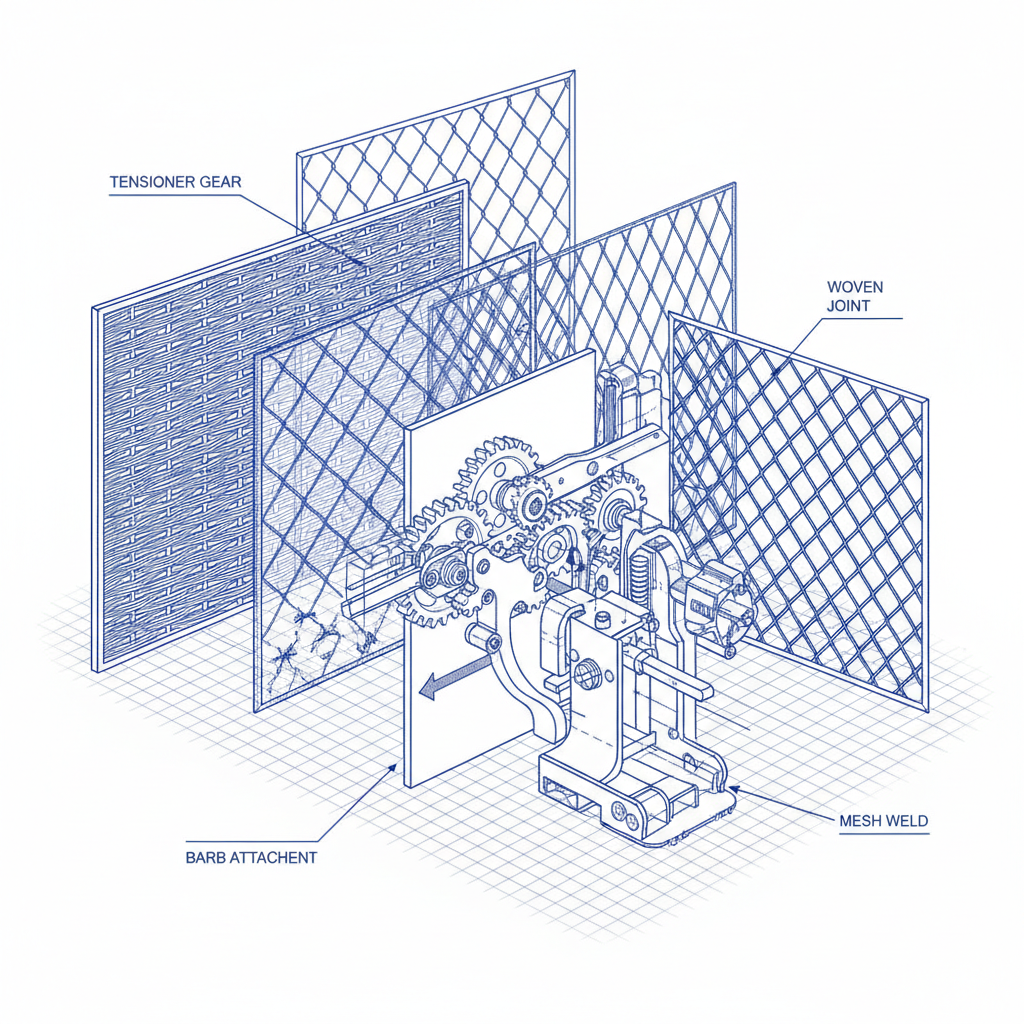
In the modern landscape of perimeter security, the demand for specialized barriers has led to the development of high-security configurations like the 358 security fencing system. While many search for versatile options such as wire mesh 25mm, the industrial standard for maximum deterrence often shifts toward tighter apertures that eliminate climbing opportunities. Understanding the balance between mesh size, material strength, and security goals is essential for protecting critical infrastructure globally.
The global shift toward urban safety and the protection of sensitive sites—ranging from airports to prisons—has elevated the importance of anti-climb technology. Traditional fencing often fails because it provides footholds or is easily breached with basic cutting tools. The evolution of high-strength welded mesh addresses these vulnerabilities by utilizing precise engineering to create a physical and psychological deterrent.
For procurement managers and security experts, selecting the right material, such as a professional-grade wire mesh 25mm or the more restrictive 358 system, depends on the specific risk profile of the site. By integrating ISO-certified manufacturing standards and corrosion-resistant coatings, these systems provide long-term value, reducing maintenance costs while ensuring an impenetrable perimeter.
The Engineering Logic of High Security Mesh
The engineering behind high-security fencing focuses on the elimination of leverage. While standard wire mesh 25mm configurations offer general-purpose partitioning, the 358 system utilizes a much tighter 76.2mm x 12.7mm mesh. This specific aperture size is critical because it is too small to allow human fingers or toes to gain a grip, effectively neutralizing the ability to climb without specialized external aids.
Furthermore, the structural integrity is derived from high-strength steel that is welded at every intersection. This prevents the "spreading" of the mesh that often occurs with woven options, ensuring that the barrier remains rigid even under extreme mechanical stress. This combination of narrow openings and weld strength makes it a superior choice for facilities where security breaches could have severe consequences.
Global Relevance of Anti-Climb Barriers
On a global scale, the protection of critical infrastructure—such as power grids, water treatment plants, and transport hubs—has become a priority for governments following ISO and international safety standards. The implementation of high-security mesh is no longer just about keeping people out, but about creating a controlled environment that integrates with electronic surveillance.
In many industrial zones, the transition from basic wire mesh 25mm to specialized anti-climb systems is driven by the need to reduce human intervention in security monitoring. When the physical barrier is inherently "unclimbable," the risk of breach is drastically lowered, allowing security teams to focus on high-level threats rather than constant perimeter patrols.
The economic impact of security breaches in transport hubs like airports can be catastrophic, involving not only financial loss but also safety risks. By utilizing high-strength steel grids that resist both cutting and bending, facilities can meet stringent regulatory requirements while ensuring that the perimeter remains intact against professional-grade equipment.
Core Components of 358 Security Systems
The effectiveness of a security system relies on more than just the mesh. While a standard wire mesh 25mm provides basic enclosure, the 358 system integrates specialized anti-lift clips and reinforced posts. These components ensure that the panels cannot be lifted or dismantled from the posts, eliminating one of the most common bypass methods used by intruders.
Material selection is the second pillar of this system. The use of high-strength steel, combined with hot-dipped galvanization or powder coating, ensures that the fence resists corrosion even in coastal or humid environments. This ensures that the structural properties of the mesh do not degrade over time, maintaining the anti-climb and anti-cut characteristics throughout its lifespan.
Finally, the visual deterrent factor plays a psychological role in security. The imposing appearance of a professional high-security fence signals to potential intruders that the facility is well-protected. When paired with surveillance cameras, the clear sightlines provided by the mesh allow for maximum visibility, ensuring that any attempt to tamper with the barrier is immediately detected.
Performance Analysis and Cost Efficiency
When analyzing the cost of high-security fencing, it is important to differentiate between upfront capital expenditure and long-term operational costs. While specialized systems may have a higher initial price point than a standard wire mesh 25mm, they significantly reduce the need for frequent repairs and manual security patrols.
Factors such as mesh density, panel height, and surface treatment directly influence the final bulk purchase price. However, the investment is offset by the fence's longevity and its ability to comply with ISO9001 and ISO14000 standards, ensuring environmental responsibility and consistent quality.
Security Performance Comparison: 358 vs Standard Wire Mesh
Real-World Applications in High-Risk Zones
In airports and transport hubs, the balance between security and visibility is paramount. The high-security mesh allows security personnel and CCTV systems to have an unobstructed view of the perimeter, which is a significant advantage over solid walls. This ensures that unauthorized access attempts are spotted instantly, while the physical structure prevents the intruder from scaling the fence.
Commercial properties, including warehouses and retail centers, also benefit from these systems. By replacing a basic wire mesh 25mm with 358 security fencing, businesses can protect high-value assets and restrict access to sensitive areas without sacrificing the professional aesthetic of their facility.
Long-Term Value and Sustainability
Sustainability in the metal products industry is defined by the lifespan of the material and the energy required for its maintenance. High-security fencing is designed for long-term exposure to harsh outdoor conditions. The use of galvanized steel ensures that the product does not require frequent painting or chemical treatments, reducing the environmental footprint over several decades.
From a financial perspective, the long-term value is found in the reduction of security incidents. A single breach at a high-security site can cost thousands of dollars in damages and lost productivity. Investing in a robust system from a reputable supplier like SHENZHOU TIKE METAL CO.,LTD ensures that the perimeter is a reliable asset rather than a recurring liability.
Moreover, the compliance with ISO14000 standards means that the manufacturing process prioritizes environmental responsibility. This makes it an ideal choice for corporations with strict ESG (Environmental, Social, and Governance) goals who still require the highest level of physical security for their global operations.
Implementation Challenges and Solutions
One of the primary challenges in installing high-security mesh is the precision required for panel alignment and the secure fitting of anti-lift clips. Improper installation can create small gaps that could be exploited. The solution lies in utilizing integrated installation support from the supplier, ensuring that the posts are reinforced and the panels are locked in place according to engineering specifications.
Another common concern is the cost for large-scale bulk purchases. While a specialized mesh is more expensive than a standard wire mesh 25mm, buyers can optimize costs by choosing a mix of security levels—using 358 mesh for high-risk zones and standard welded mesh for lower-risk boundaries.
Finally, environmental corrosion in coastal regions can be a hurdle. To overcome this, the use of PVC coatings over galvanized steel is recommended. This dual-layer protection provides a chemical barrier against salt spray and humidity, extending the service life of the fence and maintaining its structural integrity for years.
Comparative Analysis of Security Mesh Specifications
| Mesh Type |
Anti-Climb Ability |
Cutting Resistance |
Maintenance Level |
| 358 Security Mesh |
Excellent (10/10) |
High (9/10) |
Very Low |
| Standard Wire Mesh 25mm |
Moderate (6/10) |
Moderate (5/10) |
Low |
| Chain Link Fence |
Low (3/10) |
Low (3/10) |
Moderate |
| Woven Wire Mesh |
Moderate (5/10) |
Moderate (4/10) |
Low |
| Expanded Metal |
High (7/10) |
Moderate (6/10) |
Low |
| PVC Coated Welded Mesh |
Moderate (6/10) |
Moderate (6/10) |
Very Low |
FAQS
The primary difference lies in the aperture size. While a standard wire mesh 25mm is suitable for general containment, 358 mesh uses a much tighter configuration (76.2mm x 12.7mm). This makes 358 mesh "anti-climb" because it prevents fingers and toes from gaining a grip, whereas larger openings in standard mesh can be used as footholds.
358 security mesh is constructed from high-strength steel and welded at every intersection. This rigidity, combined with the thickness of the wires, makes it extremely difficult to cut with ordinary tools. Professional-grade cutting equipment requires significantly more time and effort, increasing the risk of detection by security personnel.
Yes, provided the correct surface treatment is selected. For coastal areas, we recommend hot-dipped galvanization combined with a PVC powder coating. This provides a dual-layer defense against salt-air corrosion, ensuring the fence maintains its structural integrity and security properties over a long period.
The main drivers of price are the height and length of the panels, the gauge (thickness) of the steel wire, and the type of surface treatment. Additionally, the inclusion of specialized hardware like anti-lift clips and reinforced posts affects the total cost. Bulk buyers can often negotiate lower unit costs for large-scale installations.
Absolutely. One of the greatest advantages of the high-security mesh is its visibility. It provides a clear line of sight for CCTV cameras and motion sensors, ensuring that there are no blind spots. This allows the physical barrier to work in tandem with electronic surveillance for a comprehensive security solution.
With high-quality galvanization and ISO-certified manufacturing, these systems are designed to last for decades. Depending on the environmental conditions and the coating used, they require minimal maintenance and can remain effective for 20-30 years without significant degradation of their anti-climb properties.
Conclusion
The transition from basic perimeter solutions to high-security systems like the 358 welded mesh represents a critical upgrade in facility protection. By prioritizing anti-climb apertures and high-strength steel, these systems address the inherent flaws of traditional wire mesh 25mm and chain-link alternatives. From airports to commercial warehouses, the integration of specialized mesh, anti-lift clips, and corrosion-resistant coatings provides a durable, low-maintenance barrier that significantly reduces the risk of unauthorized access.
As security threats evolve, the demand for barriers that combine physical strength with surveillance compatibility will only grow. Investing in ISO-certified high-security fencing is not just a purchase of materials, but a strategic investment in long-term risk mitigation and operational continuity. For those seeking the highest standard of perimeter protection, we invite you to explore our comprehensive range of security solutions. Visit our website: www.tikemetal.com